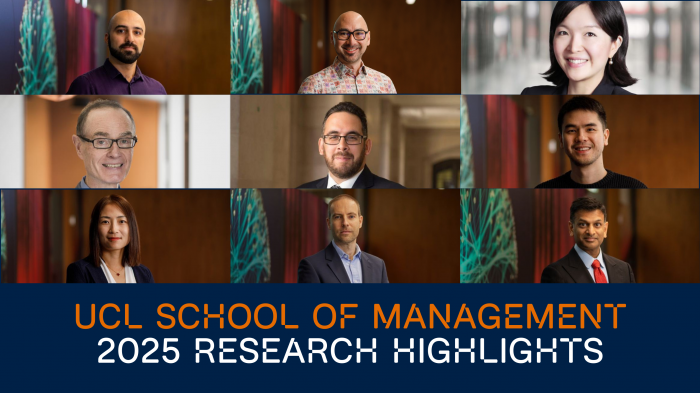
As we come to the end of 2025, we take a look back at some of our research highlights from the past year, celebrating the hard work of our academics and students.
It was difficult to choose only a few papers to highlight so we have selected one from each research group. We’re incredibly proud of our academic community and we can’t wait to see what we achieve in 2026!
organisations & innovation
Buffered by Reflected Glory? The Effects of Star Connections on Career Outcomes
Lei Liu, Martin Kilduff, Sun Young Lee, Colin M Fisher
Affiliation with a star employee can drastically shape career outcomes for employees. The “reflected glory” from being associated with top performers can even help insulate employees from the consequences of underperformance, long after the affiliation ends, according to UCL School of Management Professors Martin Kilduff, Sunny Lee and Colin Fisher.
Published in Journal of Applied Psychology
finance, accounting & economics
Customer Data Access and Fintech Entry: Early Evidence from Open Banking
Tania Babina, Saleem Bahaj, Greg Buchak, Filippo De Marco, Angus Foulis, Will Gornall, Francesco Mazzola, Tong Yu
Open banking (OB), policies that enable customers to share their financial transaction data, helps to reshape competition and innovation in financial services according to UCL School of Management Professor Saleem Bahaj.
Published in Journal of Financial Economics
strategy & entrepreneurship
Generative Artificial Intelligence and Evaluating Strategic Decisions
Anil Doshi, Bart Vanneste, Emil Mirzayev
Strategic decisions such as selecting a business model and identifying how an organisation will actually make money are high stakes and often irreversible. With generative AI-adoption becoming widespread so quickly, the question of its ability to provide foresight and accurate prediction is vital. This paper by UCL School of Management Associate Professors Anil Doshi and Bart Vanneste, and post-doctoral researcher Emil Mirzayev, evaluates generative AI’s foresight abilities by comparing its evaluations of proposed business models with those of human experts.
Published in Strategic Management Journal
operations & technology
Consider or Choose? The Role and Power of Consideration Sets
Yi-Chun Akchen, Dmitry Mitrofanov
Consumers rarely evaluate all available products when making a purchase. Instead, they first form a consideration set - a small shortlist of options - before choosing among them. UCL School of Management Associate Professor Yi-Chun Akchen studies how much consumer choice can be explained by this shortlisting step alone, finding that consideration sets play a critical role in identifying and predicting consumer behaviour.
Published in Management Science
marketing & analytics
Can Lower(ed) Expert Opinions Lead to Better Consumer Ratings?: The Case of Michelin Stars
Xingyi Li, Yiting Deng, Puneet Manchanda, Bert De Reyck
The phenomenon of the ‘Michelin Curse’, as it is known in the restaurant industry, is when the accolade can become a burden and risk deterring core customer bases. But the impact of losing a Michelin star is less understood. UCL School of Management Professor Yiting Deng explored the impact of expert opinions on consumer satisfaction, finding that losing a Michelin star can lead to higher consumer ratings, challenging the conventional belief that losing a star is detrimental to business.
Published in Management Science
