As UCL School of Management continues to evolve through an exciting period of growth and expansion, few programmes have transformed as rapidly as the UCL MBA. In just two years, the programme has welcomed new female leadership, launched its first international immersion experience in Beijing, and is preparing to deliver in‑person teaching for its core modules for the very first time at our home in Canary Wharf.
This progress is happening against a broader landscape where representation in leadership remains uneven. According to the HESA 2023/24 report, only 14% of UK professors come from Asian backgrounds, with women making up an even smaller share. For Programme Director Professor Harveen Chugh, representation in leadership is crucial, and she proudly notes the UCL MBA’s near‑equal gender balance - with women making up 49% of the student population. The programme also offers the Woman in Senior Leadership Scholarship.
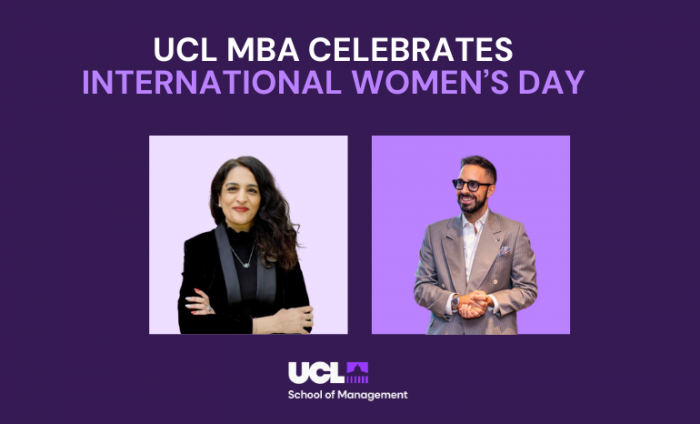
As part of our 2026 International Women’s Day commemorations, and in alignment with this year’s theme “Rights. Justice. Action. For ALL Women and Girls.”, we spoke with members of our MBA community, including Programme Director Professor Harveen Chugh, Professor Paolo Taticchi, and current MBA student Julia. Together, they reflect on women’s representation in leadership, the role of allyship in shaping equitable workplaces, and how the UCL MBA is cultivating responsible, inclusive future leaders.
a message from programme director professor harveen chugh
 This year’s International Women’s Day theme is “Rights. Justice. Action. For ALL Women and Girls.” What does this theme mean to you as a leader in business education?
This year’s theme resonates strongly with me as Director of the UCL Flex MBA. Many of the women on the programme are balancing careers, families, and leadership ambitions, and they deserve learning and working environments where their rights, experiences, and potential are fully recognised.
Justice, for me, means ensuring that every woman, whether entering leadership for the first time or progressing midcareer, has equal access to opportunity, visibility, and the confidence-building support needed to advance. The careers and coaching services we offer on the MBA plays a crucial role in this.
And action is essential. For us, it means designing classrooms that create safe spaces for discussion, actively dismantling barriers, challenging outdated norms, and equipping women with the practical tools and networks to lead with authority and authenticity. Ultimately, this theme is a reminder that progress requires intentional effort from all in business education.
Why is it important for women to be represented in senior academic and business leadership roles?
Women’s representation in senior academic and business leadership roles matters because it improves organisational performance, broadens perspectives in decision-making, and ensures that leadership reflects the communities and stakeholders organisations serve. In academia, representation also shapes who is seen as a producer of knowledge and whose expertise students are exposed to.
According to the Women in the Workplace 2025 report, over 20% of companies place low or no priority on women’s advancement, and this rises to nearly 30% for women of colour. When organisations deprioritise women’s progression, they restrict their own leadership pipeline and reinforce systemic barriers.
Representation has a powerful signalling effect. When women, particularly women of colour, see leaders who share aspects of their identity or lived experience, it demonstrates what is possible and helps normalise women’s authority in settings where they have historically been excluded. Leadership behaviour then sets the tone for what future leaders will expect, accept, and model.
Ensuring women are represented at senior levels is therefore essential not only for equity, but for creating opportunities, organisational excellence, and the development of future leaders and learners.
professor paolo taticchi talks gender equality on the mba
 How can male leaders actively support rights and justice for women in the workplace?
I am privileged to be in a senior leadership role in the School as well as a mentor and sponsor of female colleagues. For me allyship means creating an environment where women’s contributions are consistently heard, valued and represented when they are in the room and when they are not.
For example, its supporting equitable access to leadership and promotion opportunities and ensuring they are recognised for their achievements. All leaders including myself carry a responsibility to ensure women are well-supported and it’s something we need to continue to do on a daily basis incorporating it into elements of everyday practice, decisions and behaviours.
How do you incorporate conversations about equity, inclusion, and responsible leadership into your MBA classes?
In my MBA teaching I embed equity, inclusion, and responsible leadership as core strategy questions rather than standalone topics.
We use cases and live examples to examine how decisions on talent, culture, incentives, and governance shape outcomes for different groups, and I encourage students to surface assumptions, challenge bias, and translate principles into practical actions they can take as leaders.
 ucl mba student julia talks female representation in the classroom
What does this year’s theme (Rights. Justice. Action. For ALL women and girls) mean to you, and how have conversations surrounding gender equality changed throughout your career?
This theme reminds me that principles must be put into practice. In my career, I have noticed these conversations shift to the centre of how organisations consider talent, culture and leadership.
How have you found the gender split on the UCL MBA?
I am very encouraged by the diverse perspectives made visible at UCL and exemplified in its leadership and in the classroom. Women on our programme come from a wide range of backgrounds, industries, and corners of the world. Those experiences enrich our conversations and strengthen our entire cohort. I feel included and valued here.