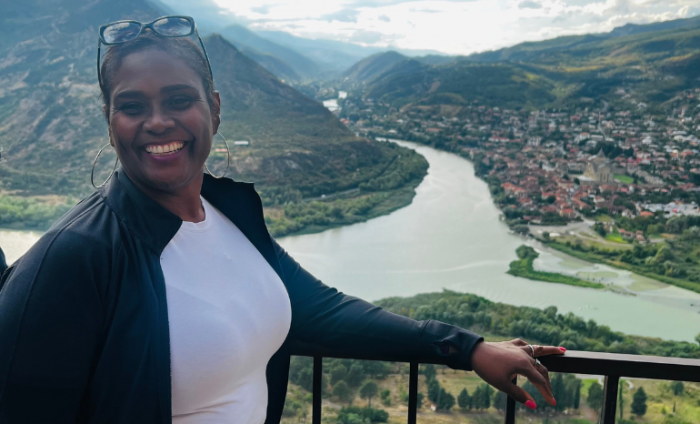
According to Times Higher Education (THE), studying an MBA - particularly a global MBA - can open doors to careers that span multiple continents and build the vital skills needed to lead international teams. For Ruth Murphy, UCL MBA student and Director of Management and Operations at U.S. Peace Corps Armenia, the programme has supported an already phenomenal career in mission-driven development work.
With more than two decades of international project management experience, Ruth has served as Media Co‑Lead for two U.S. presidential conferences, Vice President of an executive women’s organisation, and Chair of a U.S. government global conference. With such an exemplary career, Ruth was awarded the Woman in Senior Leadership Scholarship to support her studies.
Now based in Armenia, Ruth oversees all aspects of management and operations - leading the finance, HR, logistics and IT teams - to deliver the agency’s mission of world peace and international friendship. When considering an MBA, Ruth felt that the UCL MBA was the perfect choice for a busy professional looking for a globally recognised institution that could prepare her for the next stage of her international career.
We caught up with Ruth to find out more about her experience on the UCL MBA – and why she finds the programme “practical, relevant and manageable” alongside her full‑time role. Even after a stressful day at work, she tells us that she genuinely looks forward to logging on and learning.
can you tell us about your current role?
I’ve spent the last two decades of my career in international project management and development with the U.S. government. This is my fourth year with the U.S. Peace Corps and I’m currently based in Armenia where I am the Director of Management and Operations (DMO) with Peace Corps Armenia. Prior to Armenia, I served as DMO with Peace Corps Belize.
As a member of the senior management team, I’m responsible for all aspects of management and operations at post (how we refer to our programme offices overseas). I lead the finance, Human Resources, logistics and IT teams, with a particular focus on finance, operations and HR.
I absolutely love my role! It is both challenging and rewarding and no two days are the same. I have the privilege of leading a highly motivated and dedicated team who are deeply proud of their country and the contributions made by the US government. They make it their mission to ensure operations run smoothly; and staff and American volunteers have the resources and support they need to work effectively.
can you tell us about your professional background?
I hold an undergraduate degree from the University of Maryland Global Campus in Health Services Management, as well as a Master of Science in Communications and Public Relations from the same institution. I consider myself a global citizen and have always been drawn to mission-driven work.
I started out in Government about 20 years ago working in communications in HIV/AIDS programming. Our projects were primarily in sub-Saharan Africa and Southeast Asia. I’ve always felt a strong sense of purpose helping underserved communities, so public service and development were the perfect fit. Although my career began in the U.S., I knew that one day I wanted to live and work overseas.
About five years ago, I applied for the DMO position with Peace Corps, a role that was based overseas. In many ways, this felt like a full circle moment. Given that 30 years before I began my career as a locally employed staff with Peace Corps, which had a programme in my birth country of Barbados. This early opportunity planted a spark long before I immigrated to the United States. Growing up in a developing country, I always understood the importance of service, and I knew that a career in public service would be part of my future.
what have been your career highlights so far?
- I served as Media Co-lead for two U.S. presidential conferences
- I served as Vice President for an executive women’s organisation for a government agency. We were a champion for women’s issues, including advancement across the agency.
- I served as Chair for a U.S. government global conference
- I think my current role as a DMO and part of senior management with Peace Corps is also a highlight of my career. I get to sit at the table and provide input into decisions about the direction of our programme - another reason the MBA at UCL is so timely and important.
- Coordinated bilateral meetings between the US government and multilateral partners
is there much representation of women in leadership positions in your industry?
I work in government, and I’m encouraged by the level of women in leadership, especially in the most senior leadership roles in Washington. For example, the last three Directors of the Peace Corps have been women (2014-2024). Like many industries today, women in leadership aren’t perfectly aligned, but I think within Peace Corps there is a great deal of progress—at least from where I sit.
My current Country Director is male and a great ally, but prior to that, the last two country directors I worked under were outstanding women. Of course, representation matters and it’s important that we take our seat at the table. I think in public service there is still room to grow, but the Peace Corps the recognise contributions of women, and that is extremely encouraging for where I see myself in the future. I was also delighted to have been awarded the scholarship for Woman in Senior Leadership when I joined the UCL MBA.
why did you decide to pursue the ucl mba?
I work in a global space, so I wanted an MBA programme that was globally recognised and truly relevant to the work I do every day. I lead local teams and interact with counterparts/stakeholders from local communities, and I knew an MBA would enhance my skills and better prepare me for the next stage of my career in an international environment.
UCL stood out to me for several reasons. First, UCL is highly ranked as a global top 10 university. Equally important, the UCL MBA felt practical, relevant and manageable alongside my full-time position. Third, I was impressed with the range of professional and cultural backgrounds within the student body and faculty. And fourth, the executive coaching component provided on the MBA was a big draw for me, as I see leadership development as crucial to move forward in my career.
how have you found the ucl mba so far?
I completed my first graduate degree 20 years ago, and I’m definitely more ‘seasoned’ this time around. My world view has evolved, and my motivation for the work I do is very different. I am really enjoying being able to do a deep dive into the UCL MBA programme modules and supporting materials with this perspective. I completed part of my master’s programme virtually years ago, but virtual learning looked very different back then. You rarely saw your classmates or professors, coursework was submitted online and discussions were only in writing and online - that was it! UCL’s classroom approach on the MBA is much more interactive, intentional and engaging.
The online classes take place in the evening, but I genuinely look forward to logging in, even after a long or stressful day at work. It’s truly a welcome change of pace. The discussions are engaging and interesting and we often run out of time each week because there is so much to discuss and share.
I love the flexibility of self-paced study coupled with video lectures and readings. It is the perfect mix of lectures, reading and classroom interaction. Because much of the learning is focused on research and relevant real-world experiences, the pace of course and content is a great mix. I was travelling recently and was quite disappointed to miss one of my classes. I was really looking forward to the week’s discussion around data and how it drives decision-making. The faculty and staff are quite understanding and know that sometimes life and work get in the way, but from what I’ve seen, students make every effort to show up each week, cameras on, ready to engage. The dialogue is rich and thought provoking. In addition to formal learning, I am also enjoying learning from my cohort, who come from all over the globe and bring some truly impressive lived experiences into the classroom. I also look forward to being in London for the in-person Immersion in May. I’m really excited about connecting with the cohort and meeting many of the students who I’ve developed virtual relationships with already.
Find out more about the UCL Flex MBA.