UCL School of Management

Ashleigh Topping | 12 June 2026

Finance with Data Science students secure runner-up spot in 2026 PRMIA Risk Management Challenge

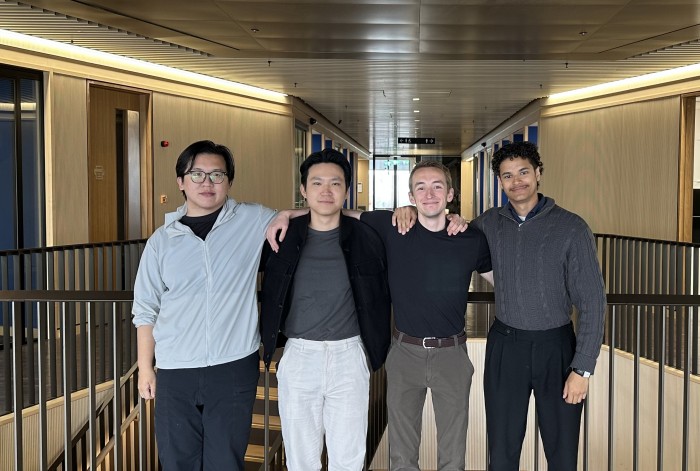
A team of UCL School of Management MSc Finance with Data Science students has secured an impressive runner-up position in the 2026 PRMIA Risk Management Challenge, competing against leading universities from around the world. Thai Nguyen, Robson Gentner, Bingchen (Eric) Jiang and Adrien Lesage demonstrated analytical rigour, strategic thinking and resilience across all three stages of this year’s competition.

Organised by the Professional Risk Managers’ International Association (PRMIA), the annual challenge places students in the role of real-world risk professionals, tasking them with navigating complex financial and geopolitical scenarios under pressure. From designing a pre-crisis framework to responding to live crisis developments and delivering Board-level recommendations, the competition tests both technical expertise and decision-making at every stage.

can you tell us about prmia and why you decided to apply?

PRMIA, the Professional Risk Managers’ International Association, is one of the leading professional bodies in risk management globally. They run the Risk Management Challenge each year, which is open to university teams across the world. The case studies are designed around real-world business and geopolitical scenarios, drawing on historical events to put students in front of risks that banks have actually faced. This year’s edition was sponsored by RBC.
 
We applied because we were interested in risk management and wanted to see how far we could go in a competition like this. The case looked intellectually stimulating, and the four of us were keen to test ourselves against teams from other universities globally.

what did the challenge involve? 

The challenge ran across three rounds between February and April 2026, all set within the same continuous case study. The format narrowed the field at each stage: 16 teams progressed to the semi-final, and 8 teams progressed to the final. Each round built directly on the assumptions and decisions we made in the previous round, so consistency across the whole arc mattered as much as quality in any single round.
 
Round 1 was set in the pre-war environment. We were given a fictional bank called GlobalBank with significant exposure to a small emerging market called Varenia, which was facing escalating geopolitical tensions with its larger neighbour Karsovia. Our task was to design a full pre-crisis risk management framework, develop stress scenarios calibrated across different escalation paths, and propose hedging and operational resilience measures. We submitted a written framework with supporting analysis.
 
Round 2 was set during the war itself. Karsovia invaded Varenia, and we entered a live two-day hackathon where we received a sequence of crisis triggers in real time, each with response windows of 30 to 75 minutes. The triggers covered market and liquidity shocks, credit deterioration, operational and cyber disruption, sanctions expansion, and a final strategic consolidation memo. The crucial point is that the triggers were designed to test whether our Round 1 framework had actually anticipated these events. For each one, we had to act under pressure, link our response back to the assumptions we made in Round 1, and document where our framework held up and where it had to adapt under real conditions. The round ended with a live panel defence over Zoom on the Sunday, where judges challenged our decisions and tested the consistency of our reasoning across the full sequence.
 
Round 3 was set in the post-war environment. Six months after the ceasefire, we were given a new context covering the bank’s realised losses, the structural weaknesses the crisis had exposed, and the fragile state of the post-conflict economy. Our task was to make Board-level recommendations on three questions: how to reform the risk appetite framework, what to do with the residual sovereign exposure, and whether to remain invested in Varenia for the reconstruction phase. The recommendations had to link explicitly back to the framework we built in Round 1 and the decisions we executed in Round 2. The finals took place in person on 16 April 2026 and were structured as a simulated Board meeting, with a CEO briefing, a Board presentation, judge Q&A, and a pressure round where we received a brand new scenario, had five minutes to consult as a team, and then presented our response live.

what was the purpose of the project and how did your team tackle it?

The purpose was to test whether we could think through a real crisis the way a risk team at a bank would, across the full arc from pre-war preparation, through in-crisis execution, into post-crisis institutional reform. We had to defend every number, assumption, and decision under live questioning from senior practitioners, with consistency maintained across all three rounds.
 
How we tackled it came down to three habits we ended up enforcing on ourselves:
 
First, we treated assumptions seriously. Every number we used had to be a defensible derivation from the limited information the case gave us, anchored in causal logic and consistent with the rest of the framework. Where we could not build that defence, the number did not make it in.
 
Second, we built causal chains rather than checklists. When modelling how a geopolitical shock transmits through a bank, we traced the chain from cyber disruption to operational outage, to market repricing, to liquidity stress, to credit migration. That gave us a defensible structure when judges asked why a particular risk mattered.
 
Third, we challenged each other hard during preparation. We argued through every recommendation and ran mock Q&A sessions where one of us would attack the team’s own position. We tried to anticipate every angle a judge might come at us from, including the ones where the decision we had made was not necessarily the most optimal one, and we accepted the discipline that if we ended up agreeing a decision was weaker than we had initially thought, we went back and reworked it rather than defending it for the sake of consistency. By the time we walked into the final, every part of the framework had already been tested by people who knew it well.
 
The rest came down to dividing the work according to each member’s strengths and trusting each other to land the pieces we owned.

Find out more about UCL School of Management’s MSc Finance with Data Science programme

Last updated Friday, 12 June 2026